Order enough custom street signs to cover every sign face on your map, plus a small reserve for the blades most likely to be stolen, struck or faded. Get Custom Street Signs makes counting simpler: the minimum is 12, every sign can carry a different name, and a free mockup arrives within 24 hours, so you can confirm the full list before anything is made.
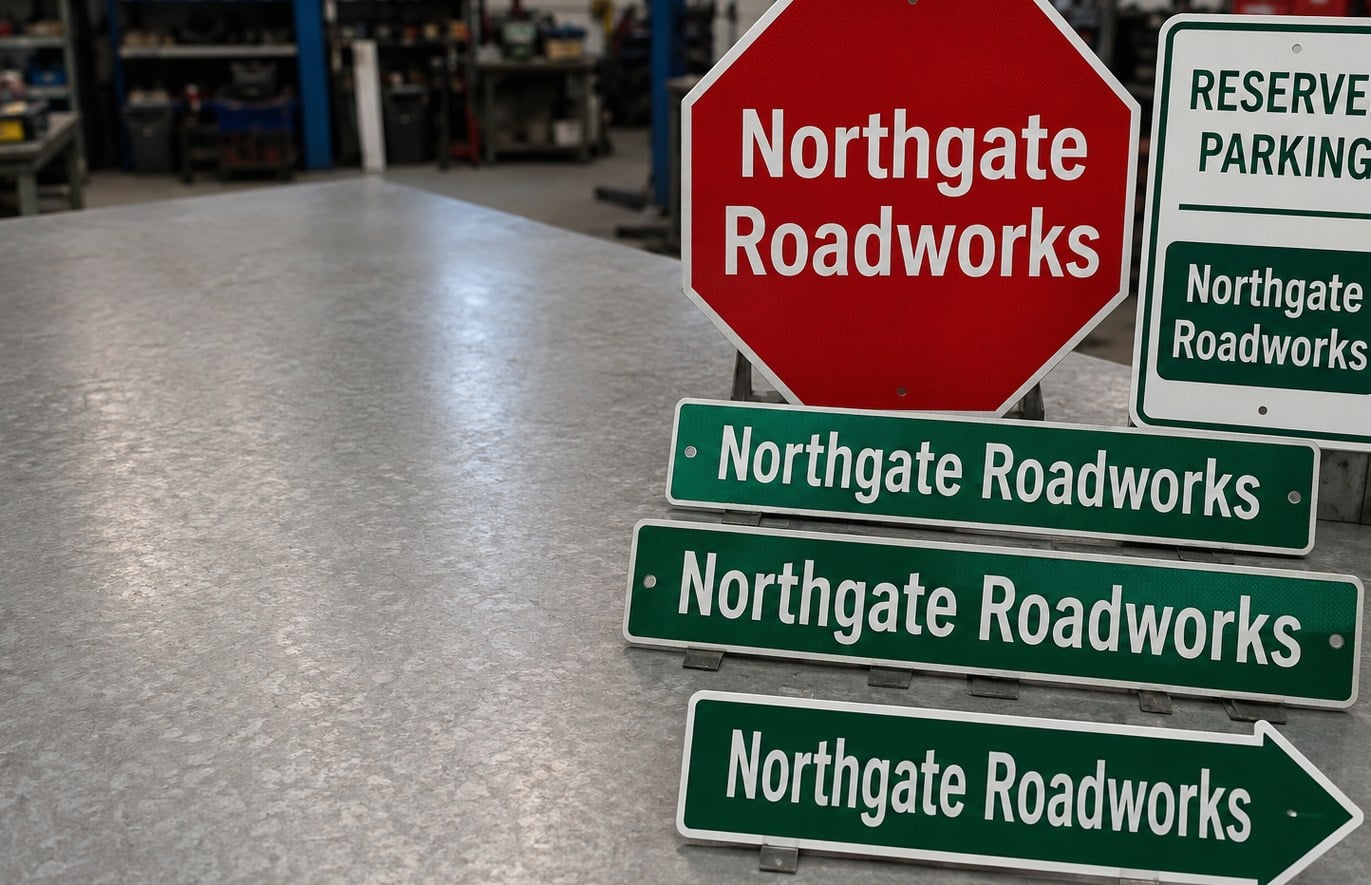
- Count street name blades per post and corner, not per street name.
- Keep spares for high-risk signs from the original run so they match exactly.
- Minimum order is 12 signs, and every sign can carry a different name.
- Free mockup within 24 hours; standard turnaround about 2 weeks after approval.
- A simple sign inventory turns every future reorder into a copy of a known list.
How many custom street signs should you order?
The right number of custom street signs is the count of sign faces your property actually needs, plus a small reserve for the signs most likely to be hit, stolen or faded first. Start from a map, not from memory: walk every intersection, entrance and parking area, and write down each sign position before you think about quantity breaks.
Most first-time buyers undercount because they picture streets rather than intersections. A single street name usually appears at every corner where it meets another road, and each corner typically carries one blade per street. A loop road with several side streets can need far more blades than the number of street names suggests.
Get Custom Street Signs has a minimum order of 12 signs, and every sign in the run can carry a different name, so even a small community can order exactly what its map shows instead of buying identical stock signs. The goal is a count you can defend line by line when the board or owner asks why the order looks the way it does.
How do you count street name blades at each intersection?
Count street name blades corner by corner: at each intersection, list which streets meet there and whether each name needs its own blade on the post. A simple crossing of two streets usually needs a blade for each street, while a T-intersection or a cul-de-sac entrance may need only the name of the side street plus the through road.
Use a numbered site map and a spreadsheet with one row per post. That single habit catches the most common counting errors:
- Number every post location on the map, including entrances from public roads.
- For each post, list every blade it carries and the exact name on each.
- Mark whether each blade is single-sided or double-sided.
- Add a column for any regulatory sign on the same post, such as a stop sign.
- Total the blades by name so you can see how many of each will be produced.
The spreadsheet then doubles as your name list for the mockup. Get Custom Street Signs builds a free mockup within 24 hours from that list, and you can compare the proof against the same rows you used to count. Details on blade styles live on the street name blades page.
Do double-sided street name blades change the quantity you need?
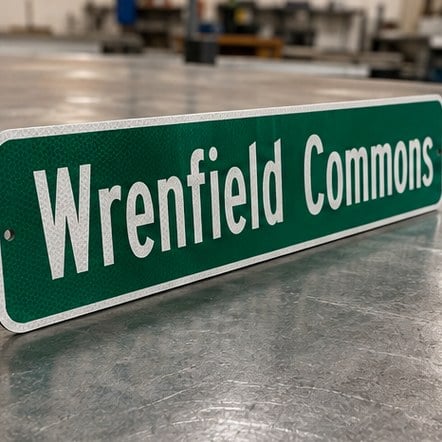
Double-sided street name blades do not reduce the number of sign positions, but they often reduce how many separate signs each post needs. A blade mounted across a corner is read from two directions, and printing the name on both faces lets one blade serve traffic coming from either side.
The decision matters most on through roads and at entrances, where drivers approach from opposite directions. A single-sided blade there forces you to choose which direction gets a readable sign, or to mount two blades back to back. On a dead-end spur or a corner that is only approached one way, a single-sided blade is usually enough.
| Location | Usual choice | Why |
|---|---|---|
| Through-road intersection | Double-sided | Drivers read the blade from both directions |
| Cul-de-sac or dead-end entrance | Single or double-sided | Depends on whether traffic exits past the same post |
| Main community entrance | Double-sided | Residents and visitors arrive and leave past it |
| Wall or fence mount | Single-sided | Only one face is visible |
Note the choice per post in your spreadsheet so the quote reflects exactly how each blade will be printed.
How many extra street signs should a community keep on hand?
A community should keep extra street signs for the specific blades that face the highest risk, not a flat surplus across every name. The signs that disappear first are predictable: blades with memorable or funny names, signs on corners where trucks and trailers turn tight, and anything near a parking area or loading zone.
Rather than guessing a percentage, rank each sign position by risk and add a reserve only where the ranking says it is needed:
- Theft risk: street names that people like to collect, or names that match a surname or a sports team.
- Impact risk: corners where delivery trucks, moving vans, motorhomes or snowplows swing wide.
- Weather risk: blades facing full afternoon sun or salt spray, which fade or weather sooner.
- Replacement delay risk: regulatory signs such as stop signs, where a missing sign is a safety problem the same day.
Keeping the reserve in the same production run means the spare is identical in color, lettering and sheeting to the sign it replaces. A replacement from a later run can match closely, but a reserve from the original batch removes any doubt. Spares count toward the order minimum of 12 like every other sign.
Should you replace every street sign at once or phase the replacement?
Replacing every street sign at once gives a community a uniform look and a single approval and installation project, while phasing spreads the work across budgets and seasons. The better choice depends on how mismatched the current signs are and whether the board can approve the full scope in one decision.
A full replacement makes sense when existing signs are a mix of styles, colors or sheeting grades, when many are faded, or when the community is rebranding. Phasing makes sense when most signs are in good shape and only certain sections, such as an older section of the neighborhood or a single parking area, need attention.
If you phase, decide the standard first. Lock the background color, lettering style, logo placement and reflective sheeting on the first order, and keep the approved mockup as the reference for every later phase. Each phase can then be ordered as its own run of 12 or more signs without drifting away from the look residents already see. The comparison on the engineer grade vs. high-intensity prismatic page helps settle the sheeting grade before phase one, since mixing grades across phases is the most visible mismatch at night.
How do you plan street sign quantities for a new development phase?
Plan street sign quantities for a new development phase from the recorded plat or the approved site plan, not from the marketing map, because street names and layouts sometimes change between early drawings and final approval. Order only for the phase whose street names are confirmed, and keep the next phase on the plan as a separate future order.
New construction adds two quantity questions that existing communities do not have. First, temporary access roads and construction entrances may need signs that will later be removed or relocated. Second, regulatory and wayfinding signs, such as stop signs, speed limits and model home directions, often go up before every street is named. Counting those separately keeps the street name list clean.
A practical sequence for builders and developers:
- Confirm the final street names for the phase with the planning office or the plat.
- Count blades per post using the corner-by-corner method.
- Add the regulatory and directional signs the phase needs on opening day.
- Request a quote and approve the mockup before roads open to residents.
Pair the street name order with stop and regulatory signs and wayfinding signs in the same run when they share a color scheme, so the whole phase arrives together.
How does turnaround time affect how many street signs you order now?
Turnaround time affects quantity because every reorder starts a new production cycle. Standard turnaround at Get Custom Street Signs is about 2 weeks after you approve the mockup, with faster turnaround available with express shipping, so a missing stop sign or blade cannot simply appear the next morning unless it is already on a shelf.
That is the real argument for ordering a reserve with the main run. A community that keeps a few spare blades and a spare regulatory sign can replace a damaged sign the day it is reported, then reorder at its own pace. A community with no reserve has to live with a missing sign for the length of a production cycle.
Work backward from any fixed date, such as a grand opening, an annual meeting or the start of the camping season. Allow for name list review, the 24-hour mockup, any revisions and roughly two weeks of production before installation. The full process is laid out step by step on the how it works page.
What should you record after the order so reorders are easy?
After a street sign order ships, record a simple sign inventory: every post location, every blade and regulatory sign on it, the exact wording, the approved mockup, and where spares are stored. That record turns the next reorder into a copy of a known list rather than a fresh survey.
Store the inventory where the next board member, property manager or maintenance lead can find it, not in one person’s inbox. Useful fields include:
- Post number and location description matching the site map.
- Sign type: street name blade, stop, speed, parking or directional.
- Single-sided or double-sided.
- Install date and the date of any replacement.
- Spare count on hand for that design.
When a sign goes missing, the maintenance lead updates the row, pulls a spare and flags the design for the next reorder. Once enough replacements build up to reach the minimum of 12, the next order can go out as a single batch. Parking areas benefit from the same tracking, especially when reserved spaces carry numbers or names, which you can order through the parking and reserved signs page.
Frequently asked questions
How do I count street name blades for a whole neighborhood?
Street name blades are easiest to count from a numbered site map with one spreadsheet row per post. List every blade on each post, the exact street name, and whether it is single-sided or double-sided, then total by name. Counting corners instead of streets prevents the most common undercount. Get Custom Street Signs can build the mockup straight from that same spreadsheet.
Does a cul-de-sac entrance need its own street name sign?
Street name signs at a cul-de-sac entrance help visitors, delivery drivers and emergency crews confirm they are turning onto the right court. Most communities place a blade at the corner where the cul-de-sac meets the through road. Whether that blade is double-sided depends on whether drivers leaving the court pass the same post and need to read the name on the way out.
Can street name blades and stop signs be combined in one order?
Street name blades and stop signs can be combined in a single order at Get Custom Street Signs, and every sign counts toward the minimum of 12. Combining them keeps colors, lettering and reflective sheeting consistent across the post. A mixed order also means the whole intersection arrives together, so the installer can mount the stop sign and blades in a single visit.
Which street signs should be prioritized when a community has to phase replacements?
Street signs that affect safety come first in a phased replacement: missing or faded stop signs, yield signs and speed signs, then blades at main entrances and through roads. Low-traffic courts and decorative signs can wait for a later phase. Locking the approved design on phase one keeps every later phase matching, even when orders are placed in different seasons.
How should leftover street signs be stored between installs?
Street signs kept in reserve should be stored flat or upright in their packaging, indoors, away from heavy objects that could bend the panel or scratch the reflective face. Label each spare with the street name and the post numbers it can replace. A maintenance closet or clubhouse storage room works well as long as the sign inventory records exactly where the spares sit.
How do I audit existing street signs before placing a reorder?
Street sign audits work best with the site map, a phone camera and the existing sign inventory. Visit each post, photograph every sign, and note anything faded, bent, missing, misspelled or mounted at the wrong angle. Compare the results with the original order. Get Custom Street Signs can then quote replacements using the corrected list instead of a fresh survey of the property.
Do double-sided street name blades cost more to plan for?
Street name blades printed on both faces need a little more planning, because each post must be marked as single-sided or double-sided before the quote. That detail changes how the run is produced, so pricing is confirmed on the quote rather than guessed. The extra planning usually pays off at through-road corners, where drivers approach from both directions and need a readable name.
How far ahead should a new subdivision order its first street signs?
Street signs for a new subdivision phase should be ordered once the street names are final on the recorded plat, early enough to allow the 24-hour mockup, any revisions and about 2 weeks of production before roads open. Get Custom Street Signs offers faster turnaround with express shipping, but ordering from a confirmed plan avoids reprinting renamed streets.
Who should keep the street sign inventory for an HOA or managed property?
Street sign inventories belong with whoever handles maintenance requests, usually the property manager or a designated board member, with a copy in shared HOA records. A single owner keeps the list current when signs are replaced or spares are used. Storing the approved mockup alongside the inventory makes future reorders faster and keeps new signs matched to the originals.
What signals that it is time to reorder street signs?
Street signs are due for a reorder when the reserve shelf runs low, when several blades show visible fading at night, or when replacement requests start arriving faster than spares can cover them. Batching those replacements into one order of 12 or more keeps the look consistent. Get Custom Street Signs returns a free mockup within 24 hours for the new batch.
Should parking area signs be counted separately from street name signs?
Street name signs and parking area signs are easier to manage as separate lines in the sign inventory, even when they ship in the same run. Parking signs are counted per space or per row, while street name blades are counted per post. Keeping the lines apart prevents gaps in either count, and both can still share colors and branding on one order.
Get a free mockup for your street signs
Send your logo or idea and the quantity you have in mind. Get Custom Street Signs returns a free mockup within 24 hours, you approve the design before anything is produced, and standard turnaround is about two weeks with faster options available. Get a custom quote.