A street sign that looks perfect in daylight can still fail the one test that matters, whether a driver can read it in headlights at night. That performance is governed by federal rules and by the reflective sheeting you choose, and the two are connected. Ordering custom street signs without understanding retroreflectivity is how communities end up with signs that are legal to install today and out of compliance in a few years. This is what the standard requires and how to pick a sheeting grade that meets it.
What the MUTCD actually requires
Street signs in the United States fall under the Manual on Uniform Traffic Control Devices, which sets minimum maintained retroreflectivity levels that a sign must keep meeting over its life, not just on day one. For the white legend on a green background used on street name and guide signs, the minimum maintained level is 120 cd/lx/m² for the white and 15 for the green. Just as important, the MUTCD requires agencies to use a systematic method to keep signs above those levels; ad hoc, replace-it-when-someone-complains maintenance is not compliant. Agencies can choose among recognized approaches, including scheduled nighttime visual inspection, measured retroreflectivity with a portable instrument, expected sign life based on installation date, blanket replacement on a fixed cycle, or a control-sign monitoring program. The rule applies to public roads open to traffic; private drives and many HOA interior streets are not federally bound, though most communities still specify to the standard because it is the defensible benchmark.
The word maintained is the one that trips people up. Every reflective sheeting loses brightness gradually as ultraviolet exposure, abrasion, and weather break it down, so a sign that measured well above 120 when new can drift below the minimum years later while still looking fine to a casual daytime glance. Compliance is judged against that floor across the sign’s whole life, which is why the standard pairs a brightness minimum with a maintenance method. It also means the grade you buy is really a decision about how long the sign stays legal, not just how bright it is on installation day.
The three sheeting grades and what they buy you
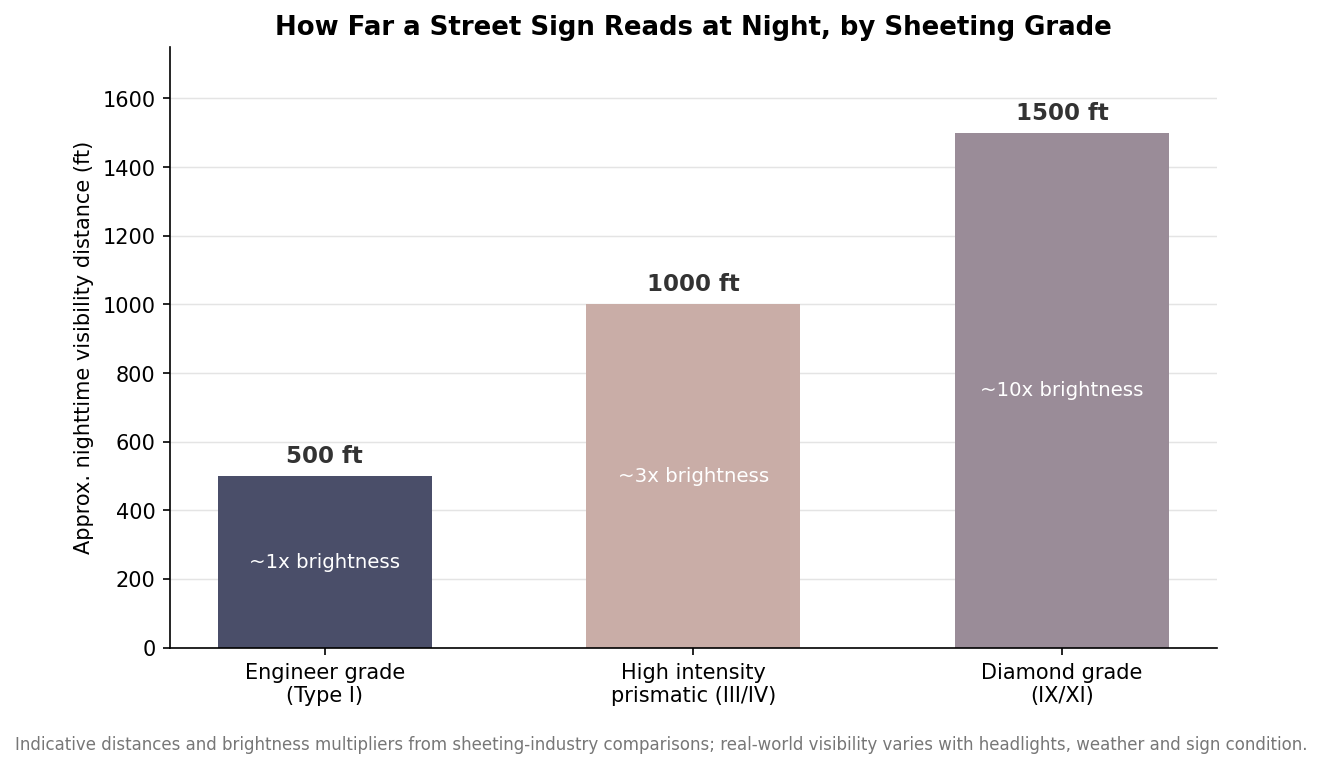
Reflective sheeting is classified under ASTM D4956, and for street signs three families cover almost every case. Engineer grade (Type I) is the entry level, built on glass beads and the least bright of the group. High intensity prismatic (Types III and IV) uses micro-prismatic optics and runs roughly three times brighter than engineer grade. Diamond grade (Types IX and XI) uses full-cube prismatic technology and returns far more light again, on the order of ten times an engineer-grade sign. Brightness is not vanity here: it translates directly into how early a driver can pick the sign out of a dark, cluttered background and still have time to react.
Reading the grade against your road
The right grade is the one that stays above the maintained minimum for the road it serves. On a low-speed private drive or a quiet residential loop, engineer grade can be adequate because approach speeds are low and reading distances are short. On through streets, higher-speed collectors, and anywhere with heavy nighttime traffic or older drivers, high intensity prismatic or diamond grade is the safer specification, because a driver traveling faster needs to read the sign from farther away to act on it. A useful way to think about it: match the sign’s readable distance to the distance a driver actually needs to see it, then step up a grade if the road is fast, poorly lit, or visually busy. Overspecifying a quiet cul-de-sac wastes money; underspecifying a busy arterial creates a hazard and a compliance gap. When in doubt between two grades for a given street, the brighter one is almost always the cheaper mistake to make.
Service life and the real cost math
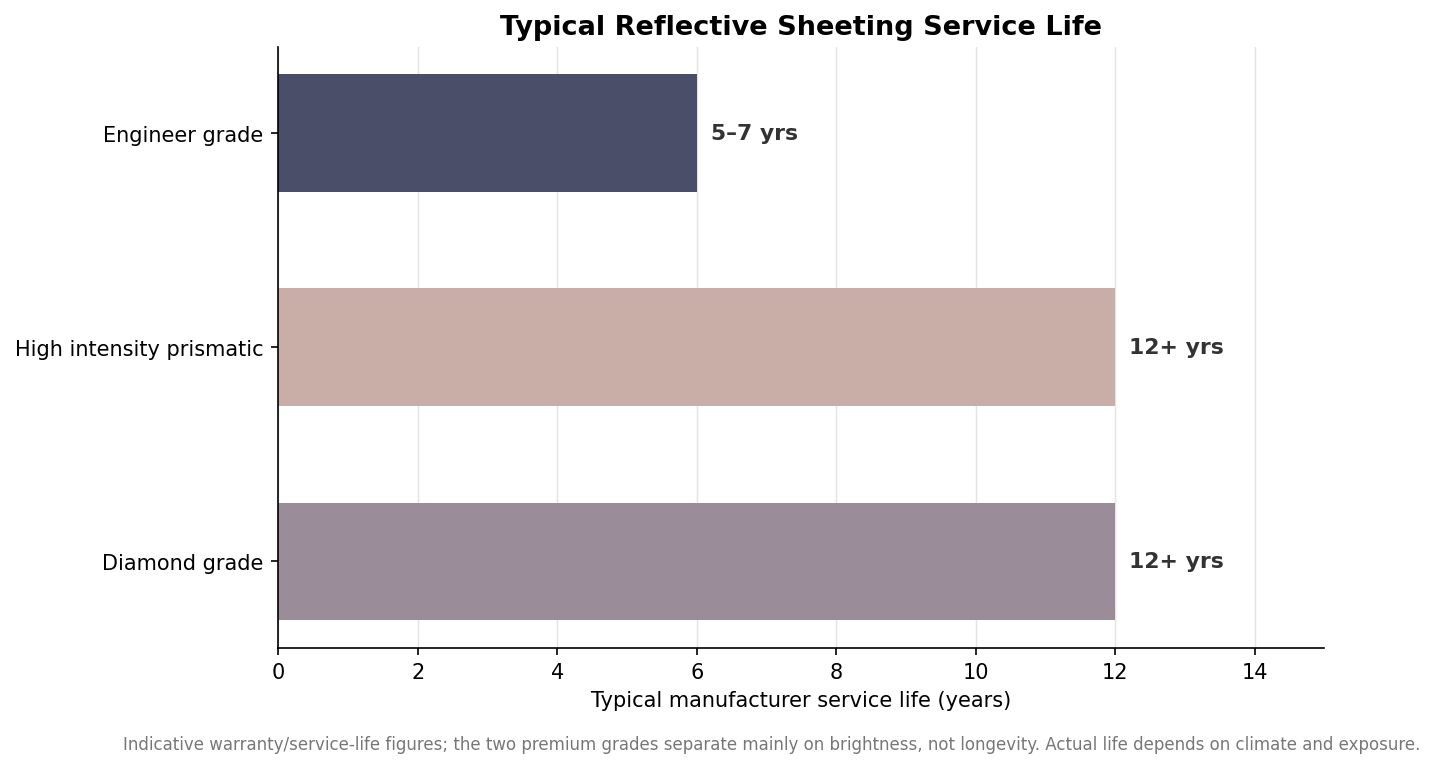
Grade also determines how long the sign holds its brightness. Engineer grade typically carries a manufacturer service life of about five to seven years, while both high intensity prismatic and diamond grade are commonly rated at twelve years or more. That gap reframes the price comparison. A cheaper engineer-grade sign can need replacing twice in the time a prismatic sign serves once, and each replacement carries not just the blank and sheeting but the labor and traffic-control cost of sending a crew out. For a community managing dozens or hundreds of signs on a maintenance schedule, the longer-life grades often cost less per year in service even though they cost more per sign at purchase.
Specifying a compliant street sign
Put the whole specification in writing before you order. Name the sheeting grade and background color, and reference the maintained retroreflectivity minimums so the supplier knows the target. Confirm the aluminum blank gauge, commonly 0.063 inch for standard street name blades and 0.080 inch for larger or higher signs that need more rigidity. Set the legend and letter height to the current MUTCD requirement, which scales up with road speed, so verify the height against the edition your jurisdiction has adopted rather than copying an old sign. Decide the mounting and any anti-theft or anti-rotation hardware for name blades. Finally, tie the order to your maintenance plan: record the installation date and sheeting grade for every sign so your systematic method has the data it needs. Specify it this way and the signs you receive are not only correct on delivery but stay compliant and legible for their full service life.